
Biosensing 9-12th grade resources
MN MedTech Pathways
Here are some of your “MN Biosensing Degrees to MedTech Job” Pathway Options
So you completed the Career Values Card Sort (https://www.icscareers.com.au/card-sort/) and discovered you’re interested in medical technology—especially biosensing: the science of detecting what’s happening inside the body and turning it into a signal we can read. From the glucose sensor on someone’s arm to the lab test that catches a disease early, biosensors are everywhere in modern medicine, and this field is growing fast.
What exactly is a biosensor?
A biosensor brings together three pieces:
– A biological recognition element — cells, enzymes, antibodies, DNA, or proteins — that “notices” the thing you want to measure.
– A transducer — electrical, optical, mechanical, or chemical — that turns that biological event into a measurable signal.
– Signal processing and data analysis that make the signal readable and useful.
You already meet biosensors all the time: continuous glucose monitors, COVID-19 rapid tests, wearable health monitors, cancer biomarker detection systems, environmental pathogen sensors, and implantable medical devices.
There’s no single “right” major
Biosensing is wonderfully interdisciplinary, so several majors lead into it. Here’s how the main ones connect:
– Biomedical Engineering — the most direct route. Combines physiology, medical devices, signal processing, sensors, materials, and regulatory know-how. Leads to roles like Biosensor Engineer, Medical Device Engineer, and R&D Scientist.
– Electrical Engineering — circuits, embedded systems, microelectronics, and wireless. Many cutting-edge biosensors are tiny electrical systems that happen to measure biology. Leads to Sensor Hardware Engineer and Wearable Device Engineer.
– Chemical Engineering — bioprocessing, microfluidics, and surface chemistry. A strong path for diagnostic and “lab-on-a-chip” biosensors. Leads to Diagnostics Engineer and Process Development Engineer.
– Materials Science & Engineering — nanotechnology, biomaterials, and conductive polymers. Next-generation biosensors rely on materials like graphene and engineered nanoparticles. Leads to Biomaterials Scientist and Sensor Materials Researcher.
– Biochemistry / Molecular Biology — proteins, antibodies, and DNA technologies. Best if you want to build the biological part of the sensor. Leads to Assay Development Scientist and Molecular Diagnostics Scientist.
– Computer Science + Data Science — machine learning, signal processing, and health informatics. Exploding right now because biosensors generate huge streams of data. Leads to Digital Health Scientist and Bioinformatics Engineer.
Three example game plans
If you’re not sure where to start, here are three routes students commonly take:
– Industry-focused: B.S. in Biomedical Engineering → internship with a medical device company → M.S. in Biomedical Engineering.
– Inventor / researcher: B.S. in Electrical Engineering or Materials Science → undergraduate research in biosensors → Ph.D. in Bioengineering.
– Entrepreneur: B.S. in Biomedical or Chemical Engineering → research experience → startup incubator → (optional) MBA later.
A smart, low-cost Minnesota pipeline: start with a Biotechnology or science transfer A.S. at a community college, transfer to UMN Twin Cities, get undergraduate research experience in biosensors or diagnostics, and intern with a company like Medtronic, Abbott, or Boston Scientific. Graduate school (a master’s or Ph.D.) is optional but valuable if you want to become a true biosensing expert rather than simply work in the field.

How education connects to careers and pay as of June 2026
Roughly speaking, the further you go in school, the more specialized (and higher-paying) the roles become. These are approximate U.S. ranges, not Minnesota guarantees:
Education | Example Jobs | Typical Salary Range |
Associate Degree | Biotech Technician, Biomedical Equipment Tech (BMET) | $50K – $80K |
Bachelor’s Degree | Biomedical Engineer, R&D Associate | $75K – $120K |
Master’s Degree | Senior Biosensor Engineer, Product Development Engineer | $100K – $150K+ |
PhD | Principal Scientist, Research Director | $130K – $250K+ |
Below is a list of MN undergraduate programs that can help launch you into the biosensing side of MedTech. Click any institution to explore what they offer—degree types, program length, tuition, transfer pathways, and the kinds of careers their grads land.
Your future in biosensing starts with exploring what’s possible. Dive in!
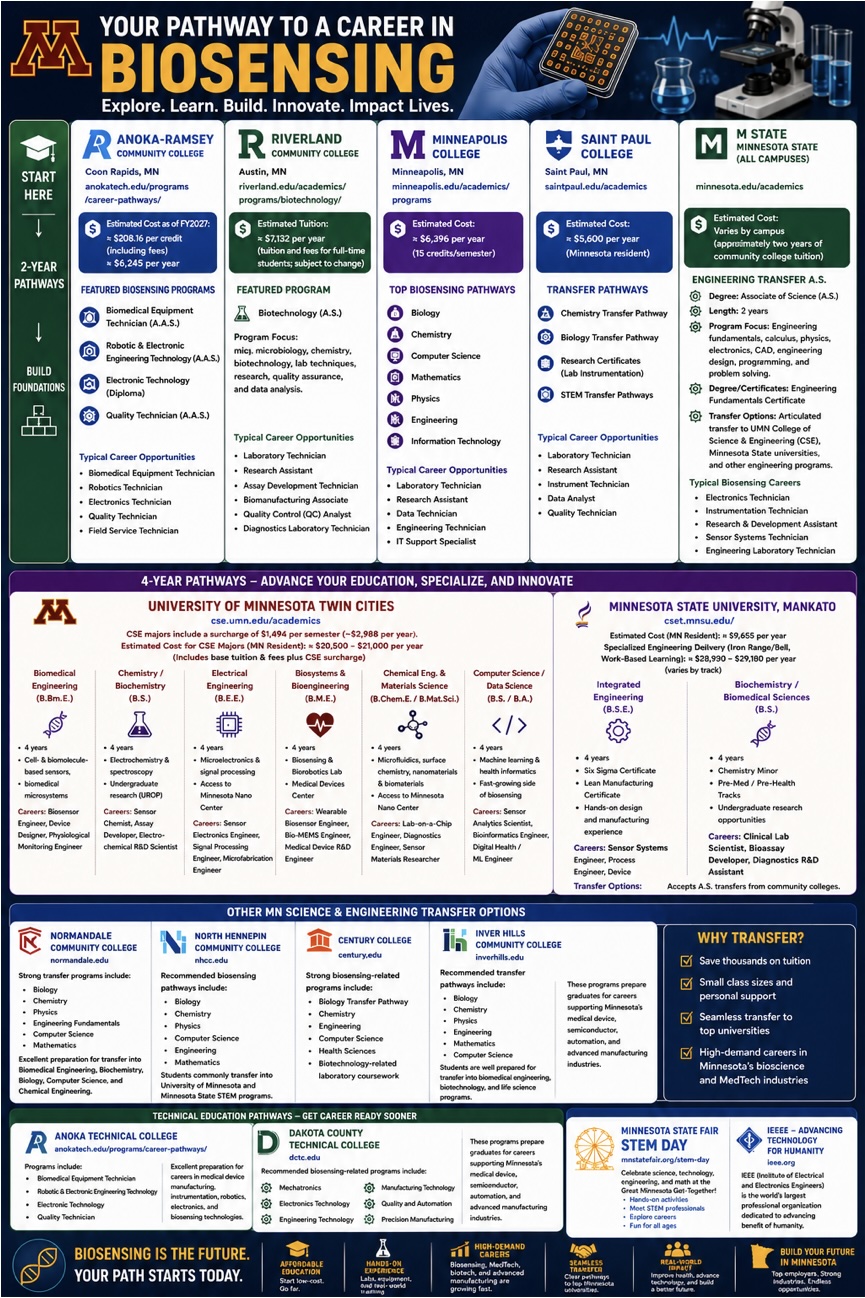
Minnesota offers many affordable community college pathways that prepare students for careers in biosensing, biotechnology, medical devices, diagnostics, digital health, semiconductors, and advanced manufacturing. Students can begin with a two-year Associate of Science (A.S.) degree or technical program, save thousands of dollars in tuition, and then transfer to a four-year university or begin working in Minnesota's growing MedTech industry.
These programs build strong foundations in biology, chemistry, physics, engineering, electronics, computer science, laboratory science, and manufacturing—all essential disciplines used to develop next-generation biosensors.
Academic Opportunities
Anoka Technical College - Coon Rapids, MN – Featured Biosensing Pathways
Explore Programs: https://www.anokatech.edu/programs/career-pathways/
Anoka Technical College offers several outstanding pathways that prepare students for careers in Minnesota's growing biosensing, medical device, advanced manufacturing, and healthcare technology industries. These programs provide hands-on experience with electronics, biomedical equipment, quality systems, robotics, and advanced manufacturing while creating affordable pathways to four-year engineering and science degrees.
Featured Biosensing Programs
Biomedical Equipment Technician
- Degree: A.A.S.
- Length: 2 years
- Estimated Tuition: Approximately $5,225 per semester
- Program Focus: Installation, maintenance, calibration, troubleshooting, and repair of medical equipment used in hospitals, clinics, and laboratories.
- Typical Careers: Biomedical Equipment Technician • Medical Device Technician • Field Service Technician • Clinical Engineering Technician
Robotic & Electronic Engineering Technology
- Degree: A.A.S.
- Length: 2 years
- Estimated Tuition: Approximately $5,225 per semester (as of June 2026)
- Program Focus: Robotics, automation, industrial electronics, programmable controls, sensors, instrumentation, and smart manufacturing.
- Typical Careers: Robotics Technician • Automation Technician • Sensor Systems Technician • Electronics Engineering Technician
Electronic Technology
- Degree: Diploma
- Length: Approximately 1–2 years
- Estimated Tuition: Approximately $5,225 per semester
- Program Focus: Electronic circuits, instrumentation, embedded systems, troubleshooting, sensors, and electrical testing.
- Typical Careers: Electronics Technician • Sensor Electronics Technician • Instrumentation Technician • Electronics Test Technician
Quality Technician
- Degree: A.A.S.
- Length: 2 years
- Estimated Tuition: Approximately $5,225 per semester
- Program Focus: Quality systems, inspection, metrology, process improvement, Lean Manufacturing, Six Sigma principles, and regulatory compliance used throughout the medical device industry.
- Typical Careers: Quality Technician • Manufacturing Quality Specialist • Validation Technician • Quality Inspector
Transfer & Career Opportunities
Graduates are well prepared for employment with Minnesota bioscience and medical technology companies including Abbott, Medtronic, Solventum, Boston Scientific, Honeywell, Seagate, Thermo Fisher Scientific, Mayo Clinic, and other advanced manufacturing employers.
Many students also continue their education by transferring into bachelor's degree programs in:
- Biomedical Engineering
- Electrical Engineering
- Mechanical Engineering
- Computer Engineering
- Manufacturing Engineering
- Biochemistry
- Biology
- Health Informatics
at institutions such as the University of Minnesota, Minnesota State University, Mankato, and other Minnesota colleges and universities.
These four programs represent some of the strongest two-year pathways into biosensing careers because they combine hands-on technical training with skills that are in high demand across Minnesota's medical device, diagnostics, semiconductor, and advanced manufacturing industries.
Riverland Community College - Austin, MN
Riverland Community College – Biotechnology: Your Gateway to Biosensing Careers
Explore the Program: https://riverland.edu/academics/programs/biotechnology/
Riverland Community College's Biotechnology Associate of Science (A.S.) degree provides an excellent foundation for students interested in biosensing, biotechnology, medical devices, diagnostics, pharmaceuticals, and laboratory science. This affordable two-year program combines biology, chemistry, microbiology, and laboratory techniques with hands-on experience that prepares graduates for immediate employment or transfer to a four-year university.
Biotechnology Associate of Science
- Degree: Associate of Science (A.S.)
- Length: 2 years (60 credits)
- Estimated Tuition: $13,844.40 total (60 credits @ $230.74 per credit; tuition and fees subject to change)
- Program Focus: Biology, microbiology, chemistry, biotechnology, laboratory techniques, scientific research, quality assurance, and data analysis.
What You'll Learn
Students develop the scientific and technical skills used throughout the biosensing industry, including:
- Biology, Microbiology, and Chemistry
- Biotechnology Laboratory Techniques
- Laboratory Safety and Good Laboratory Practices (GLP)
- Scientific Data Collection and Analysis
- Quality Control and Quality Assurance
- Technical Communication
- Problem Solving and Critical Thinking
- Research Methods
Hands-On Learning
Riverland emphasizes learning by doing. Students gain valuable laboratory experience through:
- Modern biotechnology laboratories
- Scientific research projects
- Laboratory instrumentation
- Cell culture and microbiology techniques
- Molecular biology methods
- Internship opportunities (when available)
These experiences prepare students with the practical skills employers seek in Minnesota's growing biotechnology and medical device industries.
Typical Biosensing Career Opportunities
Graduates are prepared for entry-level positions such as:
- Laboratory Technician
- Research Assistant
- Biotechnology Technician
- Assay Development Technician
- Biomanufacturing Associate
- Quality Control (QC) Analyst
- Laboratory Quality Specialist
- Medical Device Manufacturing Technician
- Diagnostics Laboratory Technician
These careers can be found in industries including:
- Medical Devices
- Biotechnology
- Pharmaceuticals
- Clinical Diagnostics
- Research Laboratories
- Biomanufacturing
- Environmental Testing
- Food Safety
- Agricultural Biotechnology
Transfer & Career Opportunities
The Biotechnology A.S. is designed to transfer seamlessly into bachelor's degree programs through the Minnesota State Transfer Pathway, providing guaranteed junior status at Minnesota State universities. Students also commonly transfer to:
- University of Minnesota Twin Cities
- Minnesota State University, Mankato
- St. Cloud State University
- Other regional universities
Popular bachelor's degree pathways include:
- Biomedical Engineering
- Biochemistry
- Biology
- Biotechnology
- Microbiology
- Molecular Biology
- Chemical Engineering
- Biomedical Sciences
- Environmental Science
Why Choose Riverland Biotechnology?
- Excellent Preparation for Biosensing Careers – Build the biology and chemistry foundation needed for medical devices, diagnostics, and biotechnology.
- Hands-On Laboratory Experience – Learn using modern laboratory equipment and scientific techniques.
- Affordable Pathway – Complete your first two years for approximately $13,844 before transferring to a university or entering the workforce.
- High-Demand Career Field – Biotechnology and biosensing careers continue to expand across healthcare, medical technology, pharmaceuticals, agriculture, and environmental science.
- Flexible Career Options – Graduates can enter the workforce immediately or continue toward advanced degrees.
Scholarships
Riverland offers scholarships to help lower the cost of your education. Biotechnology students may qualify for institutional scholarships and other financial aid opportunities.
Explore Scholarships: https://riverland.edu/paying-for-college/scholarships/
STEM
Best overall fit for biosensing because it connects to biology, chemistry, engineering, math, data, and laboratory science.
Biotechnology A.S.
Most direct pathway into biosensing.
Prepares for:
- Laboratory Technician
- Research Assistant
- Assay Development Technician
- Quality Control Analyst
- Biomanufacturing Associate
Agricultural Sciences
Strong fit for environmental and food-related biosensing.
Connects to:
- Food safety sensors
- Soil and crop monitoring
- Pathogen detection
- Agricultural biotechnology
Food Science
Excellent fit for biosensing in food safety and quality testing.
Connects to:
- Food testing labs
- Quality control
- Microbiology
- Contamination detection
Information Technology
Good fit for digital biosensing.
Connects to:
- Sensor data analysis
- Health data systems
- AI and machine learning
- Connected medical devices
Automation & Robotics
Good fit for biosensor manufacturing and lab automation.
Connects to:
- Medical device production
- Automated testing systems
- Lab robotics
- Manufacturing sensors
Supporting Matches
Healthcare
Useful for students who want to use biosensing technologies in patient care, diagnostics, radiography, nursing, EMS, or clinical settings.
Advanced Manufacturing
Good for students interested in making biosensors, medical devices, diagnostic equipment, or precision components.
Transfer Pathways
Important for students planning to continue into:
- Biomedical Engineering
- Biology
- Biochemistry
- Biotechnology
- Chemical Engineering
- Computer Science
- Data Science
- Environmental Science
Best Programs to Highlight
For your biosensing guide, I would feature:
- Biotechnology A.S.
- STEM
- Food Science
- Agricultural Sciences
- Information Technology
- Automation & Robotics
- Advanced Manufacturing
- Healthcare
- Transfer Pathways
Minnesota Industry Connections
Riverland graduates are well prepared for careers with organizations such as Abbott, Medtronic, Solventum, Thermo Fisher Scientific, Mayo Clinic, Cargill, Ecolab, university research laboratories, biotechnology startups, and other Minnesota bioscience and medical technology employers.
Riverland's Biotechnology program is one of Minnesota's strongest two-year pathways into biosensing because it combines biology, chemistry, laboratory science, and research skills that are essential for careers in diagnostics, medical devices, biotechnology, and emerging biosensor technologies.
Minneapolis College - Minneapolis, MN
Minneapolis College – Pathways into Biosensing Careers
Explore Programs: https://www.minneapolis.edu/academics/programs
Minneapolis College offers several affordable transfer pathways that prepare students for careers in Minnesota's rapidly growing biosensing, biotechnology, medical device, diagnostics, environmental science, and digital health industries. Students develop strong foundations in biology, chemistry, computer science, physics, mathematics, and laboratory science before transferring to four-year universities or entering the workforce.
Featured Biosensing Pathways
🥇 Biology
- Degree: Associate of Science (A.S.) Transfer Pathway
- Length: 2 years
- Estimated Cost: Approximately $6,396 per year (15 credits/semester)
- Program Focus: Cell biology, genetics, microbiology, ecology, anatomy, physiology, laboratory techniques, and scientific research.
- Transfer Options: University of Minnesota, Minnesota State Universities, and other four-year institutions.
- Typical Biosensing Careers: Biotechnology Laboratory Technician • Research Technician • Bioassay Technician • Clinical Laboratory Technician • Molecular Biology Technician
🥇 Chemistry
- Degree: Associate of Science (A.S.) Transfer Pathway
- Length: 2 years
- Estimated Cost: Approximately $6,396 per year (15 credits/semester)
- Program Focus: General chemistry, organic chemistry, analytical chemistry, laboratory instrumentation, and scientific analysis.
- Transfer Options: University of Minnesota, Minnesota State Universities, and other four-year institutions.
- Typical Biosensing Careers: Sensor Chemist • Assay Development Technician • Quality Control Analyst • Laboratory Scientist • Diagnostics Technician
🥇 Computer Science
- Degree: Associate of Science (A.S.) Transfer Pathway
- Length: 2 years
- Estimated Cost: Approximately $6,396 per year (15 credits/semester)
- Program Focus: Programming, algorithms, software development, artificial intelligence, data science, and computational thinking.
- Transfer Options: University of Minnesota, Minnesota State Universities, and other four-year institutions.
- Typical Biosensing Careers: Bioinformatics Analyst • Sensor Software Developer • Digital Health Developer • AI Engineer • Machine Learning Engineer
🥇 Physics
- Degree: Associate of Science (A.S.) Transfer Pathway
- Length: 2 years
- Estimated Cost: Approximately $6,396 per year (15 credits/semester)
- Program Focus: Electronics, electricity and magnetism, optics, mechanics, instrumentation, and scientific measurement.
- Transfer Options: University of Minnesota, Minnesota State Universities, and engineering programs nationwide.
- Typical Biosensing Careers: Sensor Development Technician • Optical Sensor Engineer • Instrumentation Specialist • Electronics Research Technician
🥇 Mathematics
- Degree: Associate of Science (A.S.) Transfer Pathway
- Length: 2 years
- Estimated Cost: Approximately $6,396 per year (15 credits/semester)
- Program Focus: Calculus, statistics, data analysis, mathematical modeling, and computational problem solving.
- Transfer Options: University of Minnesota, Minnesota State Universities, and engineering programs.
- Typical Biosensing Careers: Data Scientist • Bioinformatics Analyst • AI Healthcare Specialist • Sensor Analytics Scientist
Additional Programs That Complement Biosensing
These programs build valuable skills used throughout Minnesota's bioscience and medical technology industries:
- Health Sciences Broad Field – Foundation for healthcare and biomedical careers.
- Healthcare Core Curriculum – Introduction to healthcare systems and medical terminology.
- Community Health Worker – Supports digital health, patient monitoring, and public health.
- Information Technology – Networking, cybersecurity, and healthcare information systems.
- Information Studies – Data management and health informatics.
- Web Design & Front-End Development – User interfaces for medical devices and digital health platforms.
- CNC Machinist – Precision manufacturing of medical device and biosensor components.
- Welding & Metal Fabrication – Manufacturing and fabrication for medical equipment and instrumentation.
Transfer & Career Opportunities
Students commonly transfer to bachelor's degree programs in:
- Biomedical Engineering
- Biology
- Biochemistry
- Biotechnology
- Computer Science
- Electrical Engineering
- Chemical Engineering
- Physics
- Data Science
- Health Informatics
- Environmental Science
at institutions including the University of Minnesota, Minnesota State University, Mankato, St. Cloud State University, and other regional universities.
Minnesota Industry Connections
These pathways prepare students for careers with organizations such as:
- Abbott
- Medtronic
- Solventum
- Thermo Fisher Scientific
- Mayo Clinic
- Boston Scientific
- Ecolab
- Cargill
- Seagate
- Honeywell
- Collins Aerospace
- University of Minnesota research laboratories
- Minnesota biotechnology startups
Why Choose Minneapolis College?
- Affordable Tuition – Approximately $6,396 per year (15 credits per semester), making it one of Minnesota's most cost-effective pathways into STEM careers.
- Affordable Transfer Pathways that reduce the cost of earning a bachelor's degree.
- Strong Science Foundation for biosensing, biotechnology, and medical technology.
- Hands-On Laboratory Experience in biology, chemistry, and physics.
- Flexible Career Options in healthcare, biotechnology, environmental science, engineering, and data science.
- Excellent University Transfer Opportunities into Minnesota's top engineering and life science programs.
Minneapolis College provides one of Minnesota's strongest transfer pathways into biosensing by combining laboratory science, computing, mathematics, and engineering fundamentals with affordable access to four-year STEM degrees.
Additional Minnesota Science & Engineering Pathways into Biosensing
Saint Paul College
Explore Programs: https://saintpaul.edu/academics
Saint Paul College offers excellent transfer pathways that combine laboratory science, chemistry, biology, and research experience with affordable tuition. Students can earn an Associate of Science degree and transfer into bachelor's programs at Minnesota State universities or other four-year institutions.
🥇 Chemistry Transfer Pathway
- Degree: Associate of Science (A.S.)
- Length: 2 years
- Estimated Cost: Approximately $5,600 per year (Minnesota resident)
- Program Focus: General chemistry, organic chemistry, analytical chemistry, laboratory instrumentation, spectroscopy, electrochemistry, and scientific research.
- Degree/Certificates: Research Certificate with hands-on laboratory instrumentation training.
- Transfer Options: Guaranteed junior status at any of the seven Minnesota State universities pursuing a Chemistry B.S. or B.A.; additional transfer opportunities to the University of Minnesota and other institutions.
- Typical Biosensing Careers:
- Laboratory Chemist
- Assay Development Technician
- Sensor Materials Technician
- Quality Control Analyst
- Diagnostics Laboratory Technician
🥇 Biology Transfer Pathway
- Degree: Associate of Science (A.S.)
- Length: 2 years
- Estimated Cost: Approximately $5,600 per year (Minnesota resident)
- Program Focus: Cell biology, microbiology, genetics, molecular biology, biotechnology, laboratory science, and scientific research.
- Degree/Certificates: Research Certificate with biotechnology instrumentation experience.
- Transfer Options: Articulated transfer into Minnesota State universities pursuing Biology B.S. or B.A. degrees, with additional opportunities at the University of Minnesota.
- Typical Biosensing Careers:
- Biotechnology Laboratory Technician
- Bioassay Technician
- Research Assistant
- Clinical Laboratory Technician
- Molecular Biology Technician
Why Saint Paul College?
Students receive extensive laboratory experience using scientific instrumentation while building transferable skills for careers in biotechnology, diagnostics, pharmaceuticals, environmental science, and medical technology.
Minnesota State Community and Technical College (M State)
Explore Programs: https://www.minnesota.edu/academics
M State provides an affordable engineering transfer pathway that prepares students for careers in biomedical engineering, electronics, automation, robotics, semiconductor manufacturing, and medical device development.
🥇 Engineering Transfer Pathway
- Degree: Associate of Science (A.S.)
- Length: 2 years
- Estimated Cost: Varies by campus (approximately two years of Minnesota community college tuition)
- Program Focus: Engineering fundamentals, calculus, physics, electronics, computer-aided design (CAD), engineering design, programming, and problem solving.
- Degree/Certificates: Engineering Fundamentals Certificate
- Transfer Options: Articulated transfer to the University of Minnesota College of Science and Engineering (CSE), Minnesota State University campuses, and other engineering programs.
- Typical Biosensing Careers:
- Electronics Technician
- Instrumentation Technician
- Research & Development Assistant
- Sensor Systems Technician
- Engineering Laboratory Technician
Why Choose M State?
Engineering graduates build the technical foundation needed to design the electronics, sensors, embedded systems, and instrumentation that power wearable health devices, medical diagnostics, environmental monitoring systems, and next-generation biosensors.
Other Minnesota Community College Transfer Pathways
Normandale Community College
Explore Programs: https://www.normandale.edu
Strong transfer programs include:
- Biology
- Chemistry
- Physics
- Engineering Fundamentals
- Computer Science
- Mathematics
Excellent preparation for transfer into Biomedical Engineering, Biochemistry, Biology, Computer Science, and Chemical Engineering.
North Hennepin Community College
Explore Programs: https://www.nhcc.edu
Recommended biosensing pathways include:
- Biology
- Chemistry
- Physics
- Computer Science
- Engineering
- Mathematics
Students commonly transfer into University of Minnesota and Minnesota State STEM programs.
Century College
Explore Programs: https://www.century.edu
Strong biosensing-related programs include:
- Biology Transfer Pathway
- Chemistry
- Engineering
- Computer Science
- Health Sciences
- Biotechnology-related laboratory coursework
Inver Hills Community College
Explore Programs: https://www.inverhills.edu
Recommended transfer pathways include:
- Biology
- Chemistry
- Physics
- Engineering
- Mathematics
- Computer Science
Students are well prepared for transfer into biomedical engineering, biotechnology, and life science programs.
Technical Education Pathways
What is Technical Education Pathways
Students interested in entering the workforce quickly while gaining hands-on technical skills should also consider:
Anoka Technical College
Programs include:
- Biomedical Equipment Technician
- Robotic & Electronic Engineering Technology
- Electronic Technology
- Quality Technician
Excellent preparation for careers in medical device manufacturing, instrumentation, robotics, electronics, and biosensing technologies.
Dakota County Technical College
Recommended biosensing-related programs include:
- Mechatronics
- Electronics Technology
- Engineering Technology
- Manufacturing Technology
- Quality and Automation
- Precision Manufacturing
These programs prepare graduates for careers supporting Minnesota's medical device, semiconductor, automation, and advanced manufacturing industries.
Where Can These Pathways Lead?
Students completing these transfer pathways commonly continue into bachelor's degrees in:
- Biomedical Engineering
- Electrical Engineering
- Chemical Engineering
- Mechanical Engineering
- Computer Engineering
- Materials Science & Engineering
- Biology
- Biochemistry
- Biotechnology
- Chemistry
- Computer Science
- Data Science
- Environmental Engineering
- Health Informatics
Graduates are well prepared for careers with Minnesota employers such as Abbott, Medtronic, Solventum, Thermo Fisher Scientific, Mayo Clinic, Boston Scientific, Honeywell, Seagate, Collins Aerospace, Ecolab, Cargill, and many biotechnology startups and university research laboratories.
Starting at a Minnesota community or technical college is one of the most affordable pathways into biosensing. Students receive hands-on laboratory or technical experience, save significantly on tuition, and can seamlessly transfer to four-year universities or begin rewarding careers in one of Minnesota's fastest-growing industries.
University Pathways into Biosensing
University of Minnesota Twin Cities
Explore Programs: https://cse.umn.edu/academics
The University of Minnesota Twin Cities is internationally recognized as one of the nation's leading universities for biomedical engineering, medical devices, biosensing, biotechnology, and healthcare innovation. Through partnerships among the College of Science and Engineering (CSE), Medical School, Institute for Engineering in Medicine (IEM), Medical Devices Center, and industry leaders such as Abbott, Medtronic, Solventum, and Mayo Clinic, students have exceptional opportunities to participate in undergraduate research, internships, innovation challenges, and startup development.
🥇 Biomedical Engineering
- Degree: Bachelor of Biomedical Engineering (B.Bm.E.) – ABET Accredited
- Length: 4 years
- Estimated Cost (Minnesota Resident): Approximately $17,500–$19,500 per year (tuition and required fees; housing not included)
- Program Focus: Biomedical instrumentation, biosensors, physiology, biomedical microsystems, biomaterials, medical imaging, device design, signal processing, and entrepreneurship.
- Unique Opportunities:
- Cell- and biomolecule-based sensor design
- Biomedical Microsystems courses
- Medical Devices Center
- Undergraduate Research Opportunities Program (UROP)
- Institute for Engineering in Medicine
- Senior Design projects with industry
- Transfer Options: Community college transfers accepted through individual credit review from institutions including Anoka-Ramsey, Riverland, Saint Paul College, Minneapolis College, M State, Normandale, Century College, and Inver Hills.
- Typical Biosensing Careers:
- Biosensor Engineer
- Medical Device Design Engineer
- Physiological Monitoring Engineer
- Clinical Systems Engineer
- Biomedical Research Engineer
🥇 Chemistry & Biochemistry
- Degree: Bachelor of Science (B.S.)
- Length: 4 years
- Estimated Cost (Minnesota Resident): Approximately $17,500–$19,500 per year
- Program Focus: Analytical chemistry, electrochemistry, spectroscopy, molecular biology, protein chemistry, nanomaterials, biomolecular interactions, and laboratory research.
- Unique Opportunities:
- Undergraduate Research Opportunities Program (UROP)
- Advanced spectroscopy and analytical instrumentation
- Electrochemistry research
- Biomolecular sensing laboratories
- Transfer Options: Strong transfer pathway from Saint Paul College, Riverland Community College, Minneapolis College, and other Minnesota community colleges.
- Typical Biosensing Careers:
- Sensor Chemist
- Assay Development Scientist
- Electrochemical R&D Scientist
- Molecular Diagnostics Scientist
- Analytical Chemist
🥇 Electrical Engineering
- Degree: Bachelor of Electrical Engineering (B.E.E.) – ABET Accredited
- Length: 4 years
- Estimated Cost (Minnesota Resident): Approximately $17,500–$19,500 per year
- Program Focus: Electronics, embedded systems, microelectronics, signal processing, wireless communications, sensors, and integrated circuits.
- Unique Opportunities:
- Microelectronics specialization
- Signal Processing
- Access to the Minnesota Nano Center
- Semiconductor fabrication facilities
- Transfer Options: Excellent pathway from M State Engineering, Anoka Technical College, and community college engineering programs.
- Typical Biosensing Careers:
- Sensor Electronics Engineer
- Embedded Systems Engineer
- Signal Processing Engineer
- Semiconductor Engineer
- Microfabrication Engineer
🥇 Biosystems & Bioengineering (Mechanical Engineering)
- Degree: Bachelor of Mechanical Engineering (B.M.E.) with Bioengineering emphasis
- Length: 4 years
- Estimated Cost (Minnesota Resident): Approximately $17,500–$19,500 per year
- Program Focus: Biomechanics, wearable technology, robotics, microfluidics, medical devices, and human-centered engineering.
- Unique Opportunities:
- Biosensing & Biorobotics Laboratory
- Medical Devices Center
- Wearable technology research
- Industry-sponsored design projects
- Transfer Options: Community college engineering transfer pathways.
- Typical Biosensing Careers:
- Wearable Biosensor Engineer
- BioMEMS Engineer
- Medical Device R&D Engineer
- Biomedical Systems Engineer
- Product Development Engineer
🥇 Chemical Engineering & Materials Science
- Degrees:
- Bachelor of Chemical Engineering (B.Chem.E.) – ABET Accredited
- Bachelor of Materials Science & Engineering (B.Mat.Sci.) – ABET Accredited
- Length: 4 years
- Estimated Cost (Minnesota Resident): Approximately $17,500–$19,500 per year
- Program Focus: Nanotechnology, biomaterials, polymers, microfluidics, surface chemistry, advanced materials, and manufacturing.
- Unique Opportunities:
- Minnesota Nano Center
- Nanomaterials research
- Lab-on-a-Chip technology
- Biomaterials laboratories
- Transfer Options: Engineering and chemistry transfer pathways from Minnesota community colleges.
- Typical Biosensing Careers:
- Lab-on-a-Chip Engineer
- Diagnostics Engineer
- Biomaterials Scientist
- Sensor Materials Researcher
- Process Development Engineer
🥇 Computer Science & Data Science
- Degree: Bachelor of Science (B.S.) or Bachelor of Arts (B.A.)
- Length: 4 years
- Estimated Cost (Minnesota Resident): Approximately $17,500–$19,500 per year
- Program Focus: Artificial intelligence, machine learning, software engineering, bioinformatics, health informatics, and big data analytics.
- Unique Opportunities:
- AI and Machine Learning
- Digital Health
- Biomedical Data Analytics
- Collaborative research with healthcare partners
- Transfer Options: Community college Computer Science and Mathematics transfer pathways.
- Typical Biosensing Careers:
- Sensor Analytics Scientist
- Bioinformatics Engineer
- Digital Health Scientist
- Machine Learning Engineer
- AI Healthcare Engineer
Why Choose the University of Minnesota?
Students benefit from:
- World-renowned Medical Devices Center
- Institute for Engineering in Medicine
- Undergraduate Research Opportunities Program (UROP)
- Minnesota Nano Center
- Biosensing & Biorobotics Laboratory
- Strong partnerships with Abbott, Medtronic, Solventum, Mayo Clinic, Boston Scientific, and other Minnesota MedTech companies
- Paid internships and co-op experiences
- Startup and entrepreneurship opportunities
- One of the nation's largest medical device ecosystems
Minnesota State University, Mankato
Explore Programs: https://cset.mnsu.edu/
Minnesota State University, Mankato offers outstanding engineering and life science programs that prepare students for careers in biosensing, medical devices, diagnostics, biotechnology, and advanced manufacturing. The university has strong relationships with Minnesota employers and welcomes transfer students from community and technical colleges throughout the state.
🥇 Integrated Engineering
- Degree: Bachelor of Science in Engineering (B.S.E.)
- Length: 4 years
- Estimated Cost (Minnesota Resident): Approximately $10,000–$11,500 per year (tuition and fees)
- Program Focus: Engineering design, manufacturing systems, automation, robotics, quality systems, Lean Manufacturing, and Six Sigma.
- Certificates: Six Sigma Certificate and Lean Manufacturing Certificate available.
- Transfer Options: Accepts Associate of Science transfers from Anoka-Ramsey, M State, Saint Paul College, and other Minnesota colleges.
- Typical Biosensing Careers:
- Sensor Systems Engineer
- Process Engineer
- Medical Device Manufacturing Engineer
- Automation Engineer
- Product Development Engineer
🥇 Biochemistry & Biomedical Sciences
- Degree: Bachelor of Science (B.S.)
- Length: 4 years
- Estimated Cost (Minnesota Resident): Approximately $10,000–$11,500 per year
- Program Focus: Biochemistry, molecular biology, microbiology, physiology, analytical chemistry, laboratory research, and biomedical sciences.
- Program Features:
- Undergraduate research opportunities
- Chemistry minor option
- Pre-Med and Pre-Health tracks
- Faculty-mentored laboratory research
- Transfer Options: Biology and Chemistry A.S. pathways from community colleges throughout Minnesota.
- Typical Biosensing Careers:
- Clinical Laboratory Scientist
- Bioassay Development Scientist
- Diagnostics R&D Associate
- Research Scientist
- Biotechnology Laboratory Specialist
Why Choose Minnesota State University, Mankato?
Students benefit from:
- Affordable tuition
- Strong undergraduate research opportunities
- Hands-on engineering and laboratory experiences
- Industry partnerships across Minnesota
- Excellent transfer pathways
- High graduate employment rates
- Preparation for careers with Abbott, Medtronic, Solventum, Mayo Clinic, Thermo Fisher Scientific, Ecolab, Cargill, and many other Minnesota bioscience and engineering employers.
Whether students choose the University of Minnesota or Minnesota State University, Mankato, they will gain the scientific knowledge, engineering skills, research experience, and industry connections needed to build successful careers in biosensing, medical devices, biotechnology, diagnostics, digital health, and emerging healthcare technologies.
Industry Opportunities
Summary
According to the World Economic Forum, 65% of the children entering elementary school now will work in a job that doesn’t exist today. Through the Institute for Engineering in Medicine, the College of Science and Engineering and the Medical School are joining forces with Industry partners to make these possibilities real — uniting human-centered design, computation, and biomedical expertise to shape the future of healthcare. Each of the Minnesota partners below works at the frontier of biosensing, from skin-worn chemical sensors to ear-worn biometric monitoring.

Abbott
Abbott is a global leader in biosensing—its FreeStyle Libre is a coin-sized biosensor whose thin filament reads glucose in the interstitial fluid just below the skin and sends a reading to a phone every minute. The Abbott Blueprint Program is a paid summer STEM internship designed to launch high-school students into the world of medical technology. Through hands-on projects, industry mentorship, and exposure to real MedTech innovation at Abbott, students build the skills and confidence needed to take their next step toward a science or engineering career. As a partner site, the Institute for Engineering in Medicine connects students to cutting-edge biomedical labs, design studios, and clinicians across the University of Minnesota. It’s a powerful jumpstart for any student who wants to shape the future of health.
Medtronic
Igniting futures in health tech. Medtronic builds continuous glucose monitors and other sensing systems that feed real-time body data into therapies like insulin delivery. Medtronic Spark is a global, 10-year commitment to propel 1 million students from low-income households into healthcare technology careers. The initiative addresses the growing health-tech talent gap through three programs: Medtronic Spark Innovator Labs, Medtronic Spark Credentials, and the Medtronic Spark Scholarship. Together, we’re shaping the future of healthcare technology—one student at a time.
Solventum (formerly 3M Health Care)
Education and Training Programs
Solventum develops diagnostics, monitoring, and materials science that underpin many biosensing applications. Solventum is committed to supporting the education and training of healthcare professionals in the latest medical procedures and technologies. A Fellowship is an award that enables an individual medical professional to pursue study in their field or to be introduced to related fields, often advancing or enlarging the recipient’s area of interest. The award helps support activities such as training, further study, or research.
Starkey
Starkey’s Eden Prairie, MN hearing devices now double as ear-worn biosensors—tracking heart rate, activity, and fall detection alongside sound. At Starkey, Caring, Fearless, and Dedicated aren’t just words, they’re the values that drive us. They shape how we lead, how we serve, and how we connect with each other, our communities, and the world around us.
Others
Seagate
3M
Thermo-Fischer
Honeywell
Collins
Polar
Cargill
Ecolabs
Kurita America

National STEM High School Opportunities
Summary

Stanford Institutes of Medicine Summer Research Program
The Stanford Institutes of Medicine Summer Research Program (SIMR) offers high school students the chance to conduct biomedical research under the mentorship of Stanford faculty, post-docs, graduate students, and researchers. Research areas include bioengineering, bioinformatics, cardiovascular biology, and genetics—all closely tied to how biosensors are designed and validated. The program includes safety training, lectures, lab work, and a final poster session.
– Cost: Free. Minimum stipend of $500; students from underrepresented groups receive at least $1,500.
– Program Dates: June 10 – August 1 (8 weeks)
– Deadlines: Applications generally close in February
– Subject Areas: Medicine, Bioengineering, Bioinformatics
– Eligibility: High school juniors and seniors who are at least 16 and U.S. citizens or permanent residents
– Highlights: Hands-on biomedical research, mentorship, safety training, fin
Summer Intern Program at the National Institutes of Health
The Summer Intern Program at the National Institutes of Health (NIH) offers high school students a chance to engage in biomedical research at the NIH, including labs that develop sensing and diagnostic techniques. Interns work in laboratories and gain firsthand experience conducting scientific experiments and learning life-science techniques.
– Cost: Free
– Program Dates: June to August (exact dates TBA)
– Deadlines: Applications typically open in January
– Subject Areas: Biomedical Research, Health Sciences
– Eligibility: High school students interested in health-related fields
– Highlights: Hands-on research, mentorship from leading scientists, exposure to biomedical careers.
Research Science Institute
The Research Science Institute (RSI) organized by CEE, is a prestigious and highly competitive (2-5% acceptance) summer program combining hands-on STEM research with academic coursework. Participants conduct original research under the mentorship of MIT faculty, graduate students, and industry professionals—strong preparation for sensor chemistry, materials, and bioengineering. The program culminates in a symposium.
– Cost: Free
– Program Dates: June 22 – August 2 (6 weeks)
– Deadlines: Applications generally close in February
– Subject Areas: Various STEM disciplines
– Eligibility: High school students entering grades 11 or 12
– Highlights: Original research, mentorship, advanced techniques, final symposium.
Project SEED
Project SEED is a summer program from the American Chemical Society that provides high school students from underrepresented backgrounds with research opportunities in chemistry and related fields—the analytical and electrochemical foundations of biosensing. Students work with mentors in laboratories, developing their understanding of scientific methodology.
– Cost: Free
– Program Dates: June to August (exact dates TBA)
– Deadlines: Applications typically open in January
– Subject Areas: Chemistry, Biochemistry, Environmental Science
– Eligibility: High school students from underrepresented backgrounds
– Highlights: Research mentorship, lab experience, exposure to chemistry careers.
NYU’s Applied Research Innovations in Science and Engineering (ARISE)
NYU’s Applied Research Innovations in Science and Engineering (ARISE) offers high school students a summer experience blending remote workshops with in-person lab work. Projects span bio- and molecular engineering, chemical engineering, computer science, and AI/ML—all relevant to building and analyzing biosensors. Each student is matched with a mentor and lab based on their interests.
– Cost: Free, with a minimum $750 stipend
– Program Dates: June 3 – August 9 (10 weeks)
– Deadlines: Applications typically close in March
– Subject Areas: STEM (bio- and molecular engineering, chemical engineering, CS)
– Eligibility: Students living in New York City completing 10th or 11th grade by the program start date
– Highlights: Lab research, mentorship, college advising, research ethics, concluding colloquium.
Horizon Academic Research Program
The Horizon Academic Research Program - STEM Tracks offers trimester-long research programs for high school students in fields such as data science, biology, chemistry, and neuroscience—useful tracks for the chemistry and data sides of biosensing. You select a track, pair with a professor or Ph.D. scholar, and produce a 20-page university-level research paper.
– Cost: Financial aid available
– Program Dates: Summer (June 24 – September 2) and Fall (October 23 – February 19) seminars
– Deadlines: May 21 (summer), September 25 (fall)
– Subject Areas: Data Science, Biology, Chemistry, Neuroscience
– Eligibility: High school students with a GPA above 3.67
– Highlights: Personalized mentorship, publication opportunities, detailed feedback.
Lumiere Research Scholar Program
The Lumiere Research Scholar Program pairs high-school students with Ph.D. mentors for 1-on-1 independent research across subjects including engineering, chemistry, computer science, and data science. Over 12 weeks you develop an independent research paper on a topic of your choosing.
– Cost: Financial aid available
– Program Dates: Cohorts run year-round (12 weeks each)
– Deadlines: Vary by cohort
– Subject Areas: Engineering, Chemistry, Data Science, Computer Science
– Eligibility: High school students with strong academic backgrounds
– Highlights: 1-on-1 mentorship, hands-on advanced topics, analytical skill development.
MIT Introduction to Technology, Engineering, and Science (MITES)
The MIT Introduction to Technology, Engineering, and Science (MITES) summer program is an intensive experience for U.S. high school juniors (3-10% acceptance). Students take life sciences, physics, humanities, and a project-based elective—past electives include genomics and electronics, both central to biosensing—and gain access to MIT labs.
– Cost: Free. Housing and meals provided.
– Program Dates: June – August (6 weeks)
– Deadlines: Applications generally close in February
– Subject Areas: STEM
– Eligibility: U.S. high school juniors
– Highlights: Intensive STEM curriculum, MIT lab access, written evaluation.
Anson L. Clark Scholars Program at Texas Tech University
The Anson L. Clark Scholars Program offers hands-on research across fields including engineering, biology, chemistry, and electrical and computer engineering. This selective program takes 12 students who receive faculty mentorship plus seminars, workshops, and field visits.
– Cost: Free (students receive a $750 stipend, plus free housing and meals)
– Program Dates: June 16 – August 1 (7 weeks)
– Deadlines: Applications close in February
– Subject Areas: Engineering, Biology, Chemistry, Computer Science
– Eligibility: Students at least 17 years old who are U.S. citizens or permanent residents
– Highlights: Hands-on research, faculty mentorship, seminars, stipend provided.
National Youth Science Camp
The National Youth Science Camp offers students interested in biology, physics, and chemistry hands-on research opportunities. Participants run experiments and collaborative projects, attend lectures from prominent scientists, and build the critical-thinking skills behind sensor science.
– Cost: Free
– Program Dates: June 17 – July 11
– Deadlines: February 15
– Subject Areas: Physics, Biology, Chemistry
– Eligibility: High school seniors
– Highlights: Research experience, scientist mentorship, collaborative learning.
MIT OpenCourseWare
MIT OpenCourseWare offers high school students free access to courses in engineering, physics, chemistry, and mathematics—a self-paced way to build the electronics and chemistry foundations that biosensing draws on.
– Cost: Free
– Program Dates: Self-paced
– Deadlines: N/A
– Subject Areas: Engineering, Physics, Chemistry, Math
– Eligibility: High school students
– Highlights: Comprehensive materials, self-directed learning, college prep.